







🎧 Listen to This Article
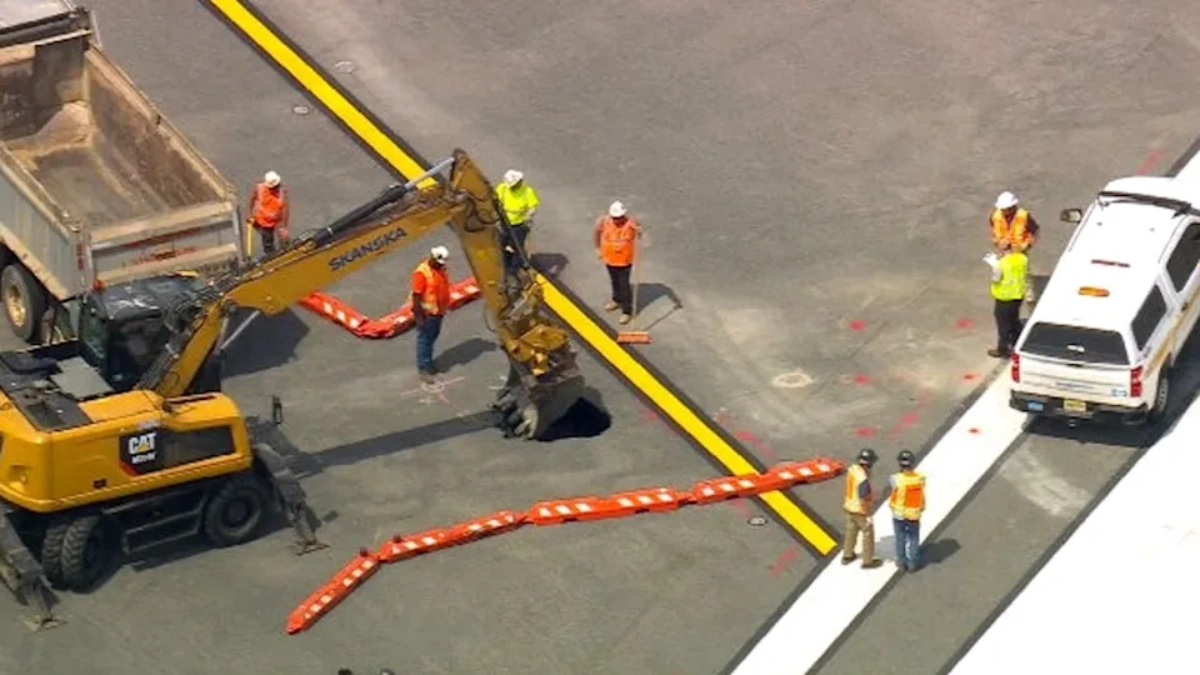
The structural margins of the United States’ most congested airspace have just hit a critical bottleneck. Today, Thursday, May 21, 2026, the Port Authority of New York and New Jersey is executing emergency stabilization maneuvers following the sudden discovery of an active LaGuardia Airport Runway Sinkhole 2026 event.
Spotted during a routine daily morning airfield inspection near the edge of Runway 4/22, the subterranean structural failure forced air traffic controllers to implement an immediate safety shutdown of the airstrip. Operating on a highly optimized, dual-runway layout, the sudden loss of a primary runway has stripped the vital domestic transit hub of half its total operational capacity, triggering an immediate logistics crisis across the Eastern Seaboard.
The 50% Capacity Squeeze at the Queens Hub
LaGuardia’s infrastructure leaves zero margin for geographic or operational variance. With the emergency Runway 4/22 Closure LGA order in full effect for heavy engineering evaluation, all commercial takeoffs and landings have been diverted to the airport’s single remaining strip, Runway 13/31.
The operational strain was immediately magnified by a line of intense, severe spring thunderstorms sweeping across the New York metropolitan region, forcing the Federal Aviation Administration (FAA) to implement strict traffic flow restrictions. This multi-layered crunch quickly expanded into deep logistical friction points:
- Massive Cancellation Cascades: Flight tracking data shows over 400 combined arrivals and departures proactively canceled or delayed. Delta Air Lines, which anchors its major domestic Northeast hub out of LaGuardia and commands roughly 40% of the airport’s total traffic, bore the brunt of the shock, resulting in extensive Delta Air Lines Flight Cancellations LGA metrics with more than 90 individual itineraries completely axed.
- The Regional Airspace Domino Effect: Because the New York airspace corridor is the most tightly woven in the country, the capacity collapse at LGA quickly spilled over into neighboring hubs, triggering widespread Northeast Airspace Aviation Delays. The FAA was forced to restrict standard arrival routes over Long Island, triggering lengthy ground delay programs at both John F. Kennedy International Airport (JFK) and Newark Liberty International Airport (EWR).
- The Ground Transportation Squeeze: Compounding the headache for corporate travel desks, alternative ground options vanished simultaneously. A fast-moving, massive brush fire along the railroad tracks in Secaucus, New Jersey, forced Amtrak to suspend regional rail services out of New York Penn Station, trapping travelers in a multi-modal transit block just days ahead of the record-breaking Memorial Day holiday weekend.
Measuring Airfield Flow Efficiency: Plain-Text Operations Model
To help corporate analysts and aviation risk desks cleanly map the system drag into automated tracking platforms without encountering database formatting or script-rendering conflicts, the airfield asset capacity penalty is computed using a direct plain-text math formula:
Airfield Flow Efficiency = [ (Active Runways ÷ Nominal Runways) × Weather Factor ] − Sum of [ Lane Weight × Destination Delay Scaling Index ]
To break down how this tracking framework evaluates real-time supply chain friction:
- Active Runways: The number of physically available, safe runways currently in operation (statutorily locked at 1 due to the active airfield enclosure).
- Nominal Runways: The standard baseline runway configuration required to maintain normal traffic flows (fixed at a baseline of 2).
- Weather Factor: The meteorological attenuation coefficient, dynamically lowered from a perfect 1.0 down to a constrained 0.65 by active regional convective storm cells and reduced visibility parameters.
- Lane Weight: The network network-weighting factor assigned to connected high-volume domestic transit corridors (e.g., LGA-ORD, LGA-ATL).
- Destination Delay Scaling Index: The standardized arrival delay multiplier cascading outward to secondary domestic transit hubs.
Whenever the efficiency index drops below a critical baseline coefficient, airlines are mathematically forced to discontinue regional short-haul commuter flights, sacrificing regional connectivity to preserve remaining open slots for larger, mainline aircraft.
The Disruption Matrix: May 21, 2026 Flight Statistics
The sudden structural layout shift disrupted arrival and departure flows across all carriers operating out of the Queens facility:
The Fragility of Reclaimed Foundations
Let’s drop the sanitized public relations terminology and look directly at the structural reality: discovering an active, subterranean sinkhole on a high-density runway like LaGuardia’s 4/22 is a major wake-up call for municipal infrastructure planning. Because LaGuardia is famously constructed on unstable reclaimed land dating back to the 1930s, it has always been highly vulnerable to shifting sub-surfaces—a geological problem highlighted by recent regional ground instability like last week’s Long Island Expressway sinkhole collapse.
In a strict two-runway configuration, you simply do not have a safety margin. Losing one strip instantly cuts your operational bandwidth in half. When you stack severe spring thunderstorms and a regional rail fire on top of that, the entire Northeast transportation network buckles. For enterprise corporate travel directors, this is a clear sign that legacy logistics sheets must have pre-built alternative routing buffers. Relying blindly on congested, single-point-of-failure regional hubs during peak season is a recipe for immediate balance-sheet friction.


Click here to open the standard version and post your comment.