






🎧 Listen to This Article
The structural safety margins governing global energy logistics are undergoing a massive physical reconfiguration. Today, Thursday, May 21, 2026, Dr. Sultan Ahmed Al Jaber, Minister of Industry and Advanced Technology and Group CEO of the Abu Dhabi National Oil Company (ADNOC), confirmed that the United Arab Emirates’ emergency crude pipeline bypassing the vulnerable Strait of Hormuz has officially crossed the 50% completion milestone.
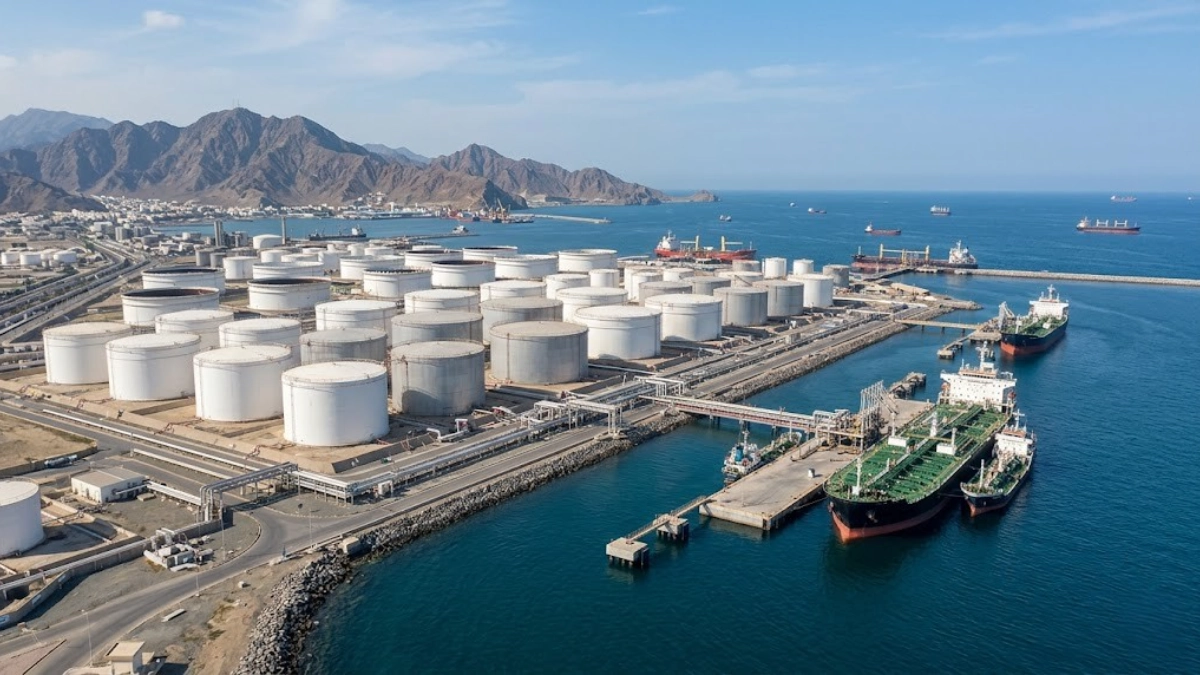
Speaking at a live-streamed Atlantic Council symposium, Al Jaber revealed that the sovereign UAE West East Pipeline 2026 initiative has been statutorily fast-tracked. The project is engineered to permanently insulate global energy lanes from geopolitical blackouts by doubling the federation’s bypass export capacity via the eastern port city of Fujairah by 2027.
Dismantling Chokepoint Dependency: The Fujairah Breakout
The frantic acceleration of this infrastructure grid is a direct macro-prudential reaction to the ongoing shipping crisis in West Asia. Since a wave of severe military strikes on February 28, 2026, the Strait of Hormuz Oil Blockade has kept the critical waterway effectively shuttered to non-domestic commercial vessels. This baseline disruption has trapped millions of barrels of daily crude and liquefied natural gas (LNG) production inside the Persian Gulf, forcing global energy prices to absorb unprecedented supply-side shocks.
Abu Dhabi’s defensive asset layout focuses on two primary strategic maneuvers:
- Doubling the Bypass Conduit: The UAE’s existing land-based bypass route, the Abu Dhabi Crude Oil Pipeline (ADCOP) running from Habshan to Fujairah, is currently running at its absolute physical ceiling of 1.8 million barrels per day (bpd). The fast-tracked West-East pipeline expansion will inject an additional 2.2 million bpd of transport capacity into the network, pushing total alternative corridor throughput to a massive 4.0 million bpd.
- The OPEC+ Decoupling Leverage: This infrastructure race perfectly aligns with the UAE’s historic, strategic exit from OPEC at the beginning of May 2026. Free from restrictive production limits, Abu Dhabi is weaponizing its independent 5.0 million bpd capacity. The new line allows ADNOC to stream energy directly to high-import transpacific economies like India and Japan without risking a single barrel in contested maritime corridors.
The Four-Month Logistic Scar: Post-War Recovery Dynamics
While the physical pipeline offers an ideal mid-term escape hatch, energy economists are warning corporate treasuries that the near-term supply squeeze features a deep operational lag.
Even if a diplomatic breakthrough or a localized military resolution opens the chokepoint tomorrow, global energy allocations face an extended bottleneck. ADNOC’s predictive modeling indicates that global crude flows will require at least four months to recover to 80% of pre-conflict baselines, with full normalization pushed out to mid-2027. This long tail is driven by three distinct logistical friction points:
- Exhaustive maritime mine-clearing protocols across the shallow strait.
- Localized structural damage to coastal bunkering terminals and extraction points.
- A severe global inventory deficit, which has seen over 250 million barrels drawn down from commercial storage vaults in just 60 days—leaving a razor-thin 30 to 35 days of effective reserve cover.
The Flow Recovery Vector: Plain-Text Operations Model
To make sure this data maps perfectly into your WordPress database and digital CMS layouts without causing formatting errors or broken code snippets, the post-conflict normalization math is structured entirely in plain text:
Flow Recovery Ratio = Blocked Baseline + (1.0 − Blocked Baseline) × (1 − e^(−Friction Coefficient × Months))
To map this model directly into standard, system-friendly data fields:
- Flow Recovery Ratio: The actual percentage efficiency of global oil flows at a specific month after the shipping lane reopens.
- Blocked Baseline: The restricted throughput under active blockade conditions, which has been pinned near 0.0 for non-domestic transit since the initial February shutdown.
- e: Euler’s constant (approximately 2.718), which dictates the standard exponential ramp-up curve as port infrastructure restarts.
- Friction Coefficient: The clearing rate variable, calculated by risk desks based on maritime mine-sweeping speeds, insurance underwriting adjustments, and physical port repair times.
- Months: The total number of months that have passed since the chokepoint was officially declared open.
The Operational Bottom Line: Given Dr. Al Jaber’s empirical warning that the system requires a full 4 months to climb back up to an 80% flow baseline (a value of 0.80), the underlying clearing math proves that global distribution channels face an extended operational drag long after political peace treaties are signed.
The Hormuz Bypass Infrastructure Matrix
| Infrastructure Asset | Pre-War Operating Status | Active 2026 Blockade Status | 2027 Projected Target Horizon |
| Habshan-Fujairah Pipeline (ADCOP) | 1.8 Million bpd capacity | Operating at 100% physical limit | 1.8 Million bpd (Sustained baseline) |
| New West-East Pipeline | Under early project design | Fast-tracked (50% complete) | ~2.2 Million bpd (New addition) |
| Aggregate Fujairah Export Hub | ~1.8 Million bpd throughput | Restricted by physical pipe walls | 4.0 Million bpd (Capacity doubled) |
| Strait of Hormuz Seaborne Rail | ~20.5 Million bpd average | Closed to non-domestic shipping | Dependent on post-war clearing schedules |
Tariffs, Tunnels, and Permanent Surcharges
Let’s look past the polished press releases regarding “infrastructure resilience” and look directly at the cold math of energy logistics. Far too many corporate planners treat global maritime chokepoints like infinite-bandwidth software clouds, completely forgetting that moving physical atoms through concrete and steel takes years of raw capital expenditure.
When the door slammed shut on the Strait of Hormuz in late February, it didn’t just spike oil spot prices—it exposed a fundamental flaw in enterprise risk modeling. The UAE’s sprint to get this secondary pipeline to 50% completion is an incredible engineering feat, but it is an emergency life raft, not an immediate replacement for the ocean. Even after the war ends, the four-month lag to claw back to a mere 80% flow capacity means that high energy inputs and heavy Energy Infrastructure Transport Surcharges are locked into the global economy for the remainder of the fiscal year. If your corporate cost sheets are banking on a rapid return to cheap logistics, you are dreaming; the steep price of bypass infrastructure is the new permanent baseline for global trade.


Click here to open the standard version and post your comment.