







🎧 Listen to This Article
The global supply chain and international mobility networks are confronting a severe dual operational shock following the official WHO Ebola PHEIC Declaration 2026 announcement. As the expanding Bundibugyo virus Ebola outbreak intensifies along the border of the Democratic Republic of the Congo (DRC) and Uganda, international administrative barriers have hardened instantly.
Today, Friday, May 22, 2026, the United States executed an immediate, sweeping 30-day travel restriction on foreign nationals who have recently transited through the affected regions. This sudden regulatory firewall is forcing multinational enterprise treasuries and global logistics providers to rapidly activate emergency contingency sheets to deal with the immediate economic fallout.
Operational Realities of the WHO Ebola PHEIC Declaration 2026
Unlike previous public health emergencies dominated by the Zaire ebolavirus—which were successfully managed via targeted ring-vaccination protocols using approved Ervebo vaccines—the active 2026 crisis is driven by the rare Bundibugyo virus strain.
The biological reality of this strain introduces unique structural risk variables for border control engines following the WHO Ebola PHEIC Declaration 2026:
- The Diagnostic and Vaccine Vacuum: There are currently no FDA-approved or globally licensed vaccines or targeted therapeutics capable of neutralizing the Bundibugyo strain. Containment relies entirely on physical isolation, intense trace-back networks, and aggressive supportive clinical care.
- Urban Infiltration Risks: The emergency announcement was accelerated after international spread markers were confirmed outside the initial epicenter of Ituri Province (DRC). Active cases have now been documented in high-density metropolitan hubs like Kampala (the Ugandan capital), Kinshasa, and via medical transport as far as Germany, signaling to border agencies that localized regional quarantines are no longer self-contained.
- The U.S. Entry Ban: In an aggressive pre-emptive maneuver, Washington’s 30-day travel restriction blocks entry to non-U.S. citizens who have been physically present within the DRC, Uganda, or South Sudan during the preceding 21-day incubation window. Concurrently, all arriving U.S. citizens with regional travel history are being diverted to specialized diagnostic screening hubs.
The Logistics Shockwave: Regional Compliance Matrix
The introduction of biological and border filters has immediately increased processing times and insurance overhead along the Northern and Central transport corridors of East Africa.
| Transit Jurisdiction / Node | Active Advisory Baseline | Enforced 2026 Emergency Status | Operational Supply Chain Impact |
| United States Ports of Entry | Level 1/3 Travel Notices | 30-Day Foreign National Ban | Absolute disruption to corporate personnel transfers and technical consulting lines. |
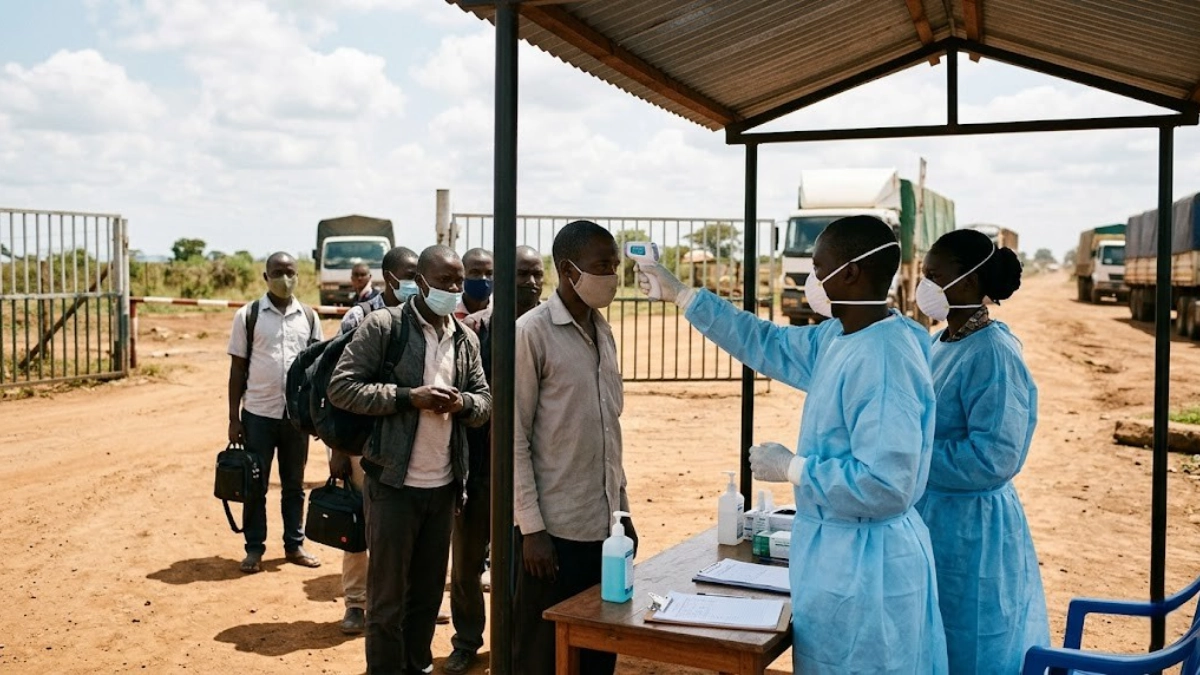
| Uganda-DRC Border Gates | Standard customs clearance | Mandatory Driver Thermal Screens | 48-to-72 hour cargo backlogs forming at primary commercial arterial junctions. |
| Inbound European Hubs | Enhanced passive monitoring | Active Point-of-Entry Sorting | Increased customs clearance latency for time-sensitive air cargo lines. |
| East African Shipping Corridors | Standard actuarial baselines | Emergency Risk Premium Surcharges | Underwriters applying 12% to 18% cost spikes to offset cargo detention liabilities. |
Measuring Systemic Drag: Plain-Text Logistical Friction Formula
To help corporate risk management desks and automated enterprise supply chains accurately model these disruptions within digital CMS systems without triggering database script errors, the added overhead is tracked using a direct, system-friendly plain-text math framework:
Logistical Friction Score = Sum of [ Checkpoint Delay Days × (1 + Restriction Multiplier × Regional Corridor Vulnerability) ] + Natural Log (1 + Delayed Cargo Volume ÷ Nominal Operating Capacity)
To map this model directly into standard asset management fields:
- Checkpoint Delay Days: The incremental asset latency duration induced by mandatory physical and biological screening lines at border checkpoints.
- Restriction Multiplier: The sovereign restriction index, statutorily locked at 1.0 for countries under an absolute travel ban and 0.0 for unrestricted lanes.
- Regional Corridor Vulnerability: The structural vulnerability coefficient of the transit corridor, heavily weighted by local infrastructure density, alternative route availability, and local security profiles.
- Delayed Cargo Ratio: The real-time mathematical ratio of delayed cargo volume relative to standard nominal operating capacity, tracking the scale of port gridlock.
When the logistical friction score spikes beyond an enterprise’s pre-programmed threshold, automated supply chain routing tools are forced to bypass regional land corridors entirely, shifting cargo parameters to slower, asset-heavy maritime configurations.
The Return of Border Hardening
Let’s cut through the sanitized diplomatic health advisories: the combination of the WHO Ebola PHEIC Declaration 2026 and Washington’s 30-day travel ban provides a brutal reality check for global mobility managers who assumed the era of sudden border closures was behind us. Because the Bundibugyo strain lacks a vaccine shield, states are reverting to the only blunt instrument they have left: raw physical exclusion.
For multinational operations running mining, logistics, or infrastructure plays across East Africa, this is an immediate bottom-line hit. You can no longer rely on seamlessly rotating high-level technical specialists into the field without facing extensive quarantine side-lining and visa rejections. In 2026, corporate resilience isn’t just about managing financial lines—it’s about ensuring your supply architecture is flexible enough to absorb sudden, emergency border friction without collapsing your entire distribution network.
Recommended Real Photo Search Terms 📸
- The Border Infrastructure Crisis:
Mpondwe border post Uganda DRC crossing commercial trucks logistics freight - Medical Screening Reality:
Health workers thermal screening checkpoint border entry Africa editorial photo - The Global Hub Screening:
Incheon international airport or JFK airport arrival terminal quarantine health inspection signs


Click here to open the standard version and post your comment.