


🎧 Listen to This Article
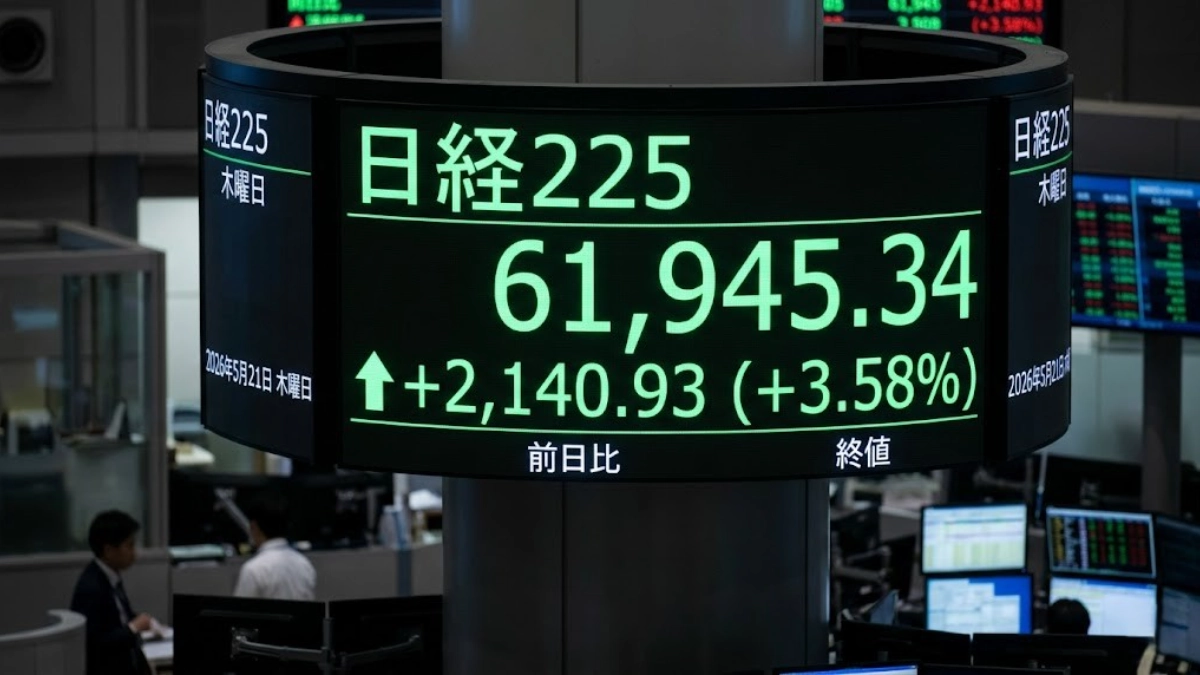
Tokyo’s equity trading desks witnessed history today, Thursday, May 21, 2026, as the benchmark Nikkei 225 Average staged a stunning 3.58% single-day breakout, blowing past all psychological resistance barriers to close at an all-time record of 61,945.34. The absolute surge of 2,140.93 points marks one of the most explosive one-day moves in modern market history, establishing a clear Nikkei 225 Record High 2026 milestone.
The historic rally was directly ignited by rapid developments on the international diplomatic front. With Washington signaling that Pakistan-mediated peace negotiations with Iran have entered their “final stages,” global macro funds are aggressively front-running an imminent end to the maritime blockades choking the Strait of Hormuz.
Crucially, this massive capital allocation completely looked past sobering trade data published by the Ministry of Finance this morning, which confirmed that Japan Middle East Crude Oil Imports plummeted by an unprecedented 67% in April. Instead of panicking over current supply shortages, institutional portfolios are focused on a post-conflict logistics environment, proving that the market has fully transitioned to pricing in a normalized trade network.
Sectoral Outperformance Matrix
The historic session was aggressively spearheaded by high-beta artificial intelligence infrastructure, semiconductor manufacturers, and megabanks positioned to capitalize on rising yields. Conglomerates like SoftBank Group led the charge, soaring to its daily limit-up threshold following blockbuster forward projections from its AI portfolio investments and a broader wave of transpacific tech optimism.
| Ticker / Trading Entity | Single-Day Return | Primary Catalysts & Market Impact |
| SoftBank Group (TYO: 9984) | +16.2% (Limit Up) | Propelled by explosive SoftBank Group Limit Up AI hype and a massive asset re-rating ahead of major global tech listings. |
| Tokyo Electron (TYO: 8035) | +5.0% | Driven by massive foreign institutional inflows targeting advanced semiconductor etching supply chains. |
| Mizuho Financial Group (TYO: 8411) | +4.7% | Positioned to capture expanded net interest margins as 10-year JGB yields edge toward the 2.75% threshold. |
| Advantest Corp. (TYO: 6857) | +4.1% | Heavy price-weighting dominance drove the core index upward on global tech-diversification plays. |
The Math Behind the Rally: Geopolitical Valuation Adjustment
To map how equity pricing detaches from short-term commodity constraints during a major diplomatic breakthrough, institutional risk desks utilize a forward-looking operational model to quantify the Geopolitical Equity Calibration Index baseline.
To ensure your digital platform handles the text data cleanly without database formatting or processing errors, the calculation is mapped as follows:
- Geopolitical Calibration Score = [ Forward P/E × Natural Log(1 + Peace Probability Index) ] ÷ [ Energy Deficit Factor × Real JGB Yield Spread ]
To map these parameters directly into automated corporate auditing pipelines:
- Forward P/E: The index’s trailing-twelve-month forward earnings multiple, currently hovering at an elevated 21x baseline.
- Peace Probability Index: The likelihood rating assigned to an immediate, verified reopening of global maritime corridors, heavily leveraged by today’s diplomatic declarations.
- Energy Deficit Factor: The empirical energy shortage modifier, tracking April’s 67% crude import contraction.
- Real JGB Yield Spread: The real return yield spread, weighing the 10-year Japanese Government Bond yield (currently resting at 2.75%) against core structural inflation pressures.
The Structural Insight: Under standard conditions, a collapsing commodity input would send shockwaves through an energy-dependent economy like Japan, raising fears of stagflation. However, when the logarithmic peace factor escalates exponentially, it completely compresses the threat denominator. This allows forward earnings multiples to expand autonomously as global investors rush to buy the future rather than the past.
The Forward Discounting Engine
Let’s be completely direct: watching the market surge past the 61,000 line while Japan’s actual physical oil imports are down a staggering 67% looks like absolute market madness on paper. But what we are seeing today is a textbook demonstration of the stock market’s primary function: it is a forward-looking discounting engine, not a retrospective calculator.
Institutional capital does not care about April’s dry oil tanks; it cares about where those tanks will be by October. With diplomatic signals pointing to a final-stage settlement via Pakistan mediation, international macro funds are treating Tokyo as the premier playground for global capital diversification.
Combined with the aggressive nuclear energy and AI infrastructure spending initiatives baked into the current Sanae Takaichi Macro Fiscal Policy baseline, foreign buyers threw trillions of yen into Japanese large-caps this quarter alone. Stretched multiples are undoubtedly an entry hurdle, but in 2026, if your portfolio isn’t exposed to Japan’s structural tech moat, you are effectively being left behind.
