


🎧 Listen to This Article
The “training wheels” have officially come off for Brazil VAT Enforcement 2026. As of today, May 1, 2026, the four-month penalty-free “learning window” for the new dual VAT system—comprising the federal CBS and sub-national IBS—has closed.
For the multinational and domestic corporations participating in the 1% pilot phase, this marks a shift from theory to high-stakes reality. Brazil is now the first major economy to fully operationalize an “intelligent split payment” mechanism, effectively automating tax collection at the moment of the digital handshake.
The Split-Payment Era: Taxation at the Speed of Light
The most revolutionary (and daunting) aspect of this enforcement phase is the Split Payment system. Gone are the days of companies collecting VAT, holding it, and remitting it weeks later.
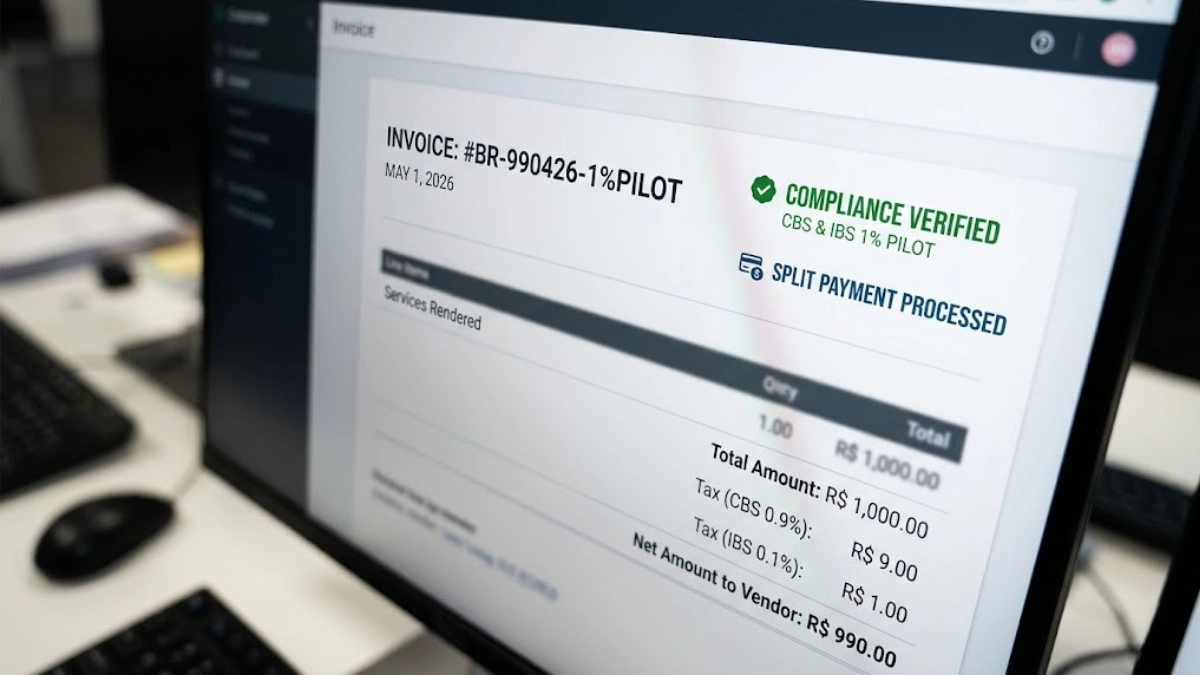
- Real-Time Siphoning: When an electronic payment is made (via credit card, PIX, or bank transfer), the banking system automatically splits the transaction. The tax portion (CBS and IBS) is sent directly to the government, while only the net amount reaches the vendor’s account.
- DF-e Layouts: The new Electronic Fiscal Documents (DF-e) are now the only legal way to trigger these payments. If your invoice layout is even slightly misaligned with the new 2026 standards, the payment could be blocked or the tax credits “lost” in the digital ether.
- The End of Leniency: During the pilot (January to April), errors were flagged but not fined. As of today, a technical glitch in your API or a mapping error in your ERP system is a taxable event subject to Brazil’s famously rigorous penalty regime.
The 1% Pilot Math: Explained
During this transition year, the tax rate remains at a combined 1% to allow the system to calibrate without causing a massive price shock.
How it works: For a transaction of 1,000 Reais, the system automatically calculates 9 Reais for the Federal CBS (0.9%) and 1 Real for the State/Municipal IBS (0.1%).
In the split-payment model, the vendor only ever sees 990 Reais enter their bank account. The other 10 Reais are siphoned off by the payment processor and remitted to the tax authorities instantly.
