


🎧 Listen to This Article
Brazil VAT Split-Payment 2026 technology has just crossed the rubicon from “ambitious pilot” to “operational reality.” Today, April 20, 2026, the Receita Federal executed the world’s first automated revenue settlement for the new IBS (Imposto sobre Bens e Serviços) and CBS (Contribuição sobre Bens e Serviços) taxes.
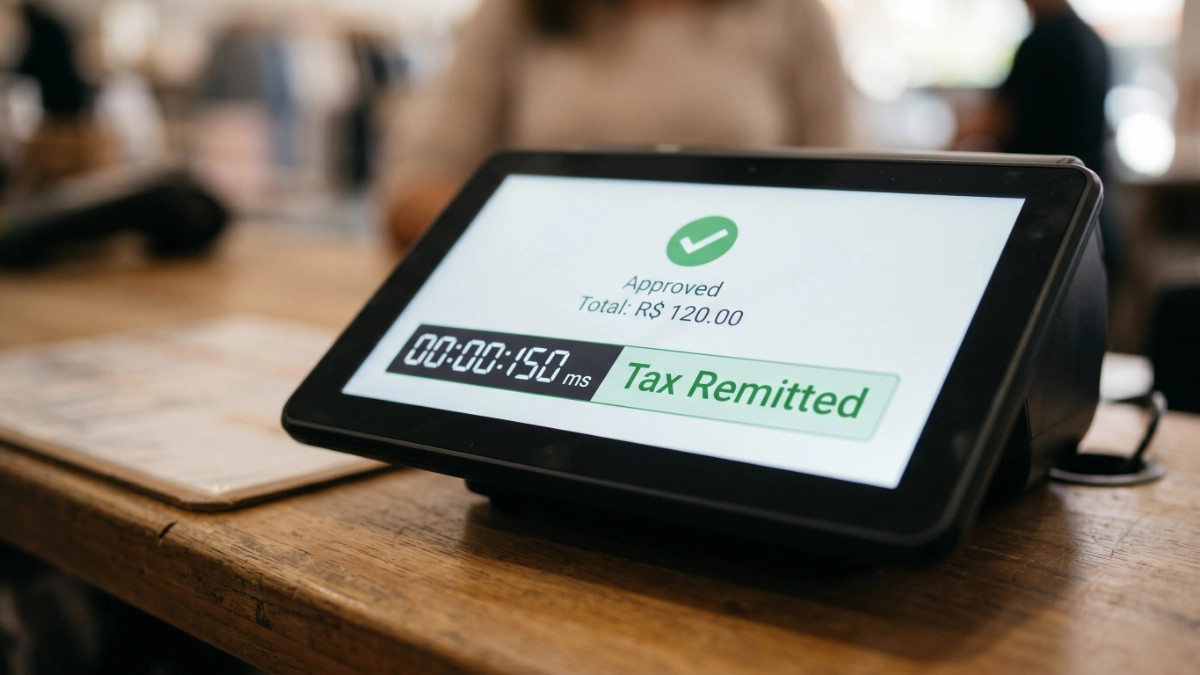
In a seamless digital operation, the tax portion of over 200 million real-time transactions was diverted directly from payment clearinghouses to federal and state treasuries. This wasn’t just a data transfer; it was the actual movement of currency, occurring at the moment of sale without a single manual entry.
The Death of the “Missing Trader”
The primary target of the Brazil VAT Split-Payment 2026 mechanism is the “Missing Trader” fraud—a scheme where businesses collect VAT from customers but vanish before remitting it to the government. By splitting the payment at the point of origin, Brazil has effectively made this type of fraud technologically impossible.
| Feature | Pre-Reform System | Brazil VAT Split-Payment 2026 |
| Collection Timing | 30–90 days post-sale | Real-time (Millisecond split) |
| Remittance | Manual filing by merchant | Automated via Clearinghouse |
| Fraud Risk | High (Missing Trader schemes) | Negligible (Systemic control) |
| Compliance Cost | High administrative burden | Low (Software-integrated) |
Scalability and Global Impact
The successful settlement of 200 million transactions in a single day proves that the system can handle the massive scale of the Brazilian economy. For the first time, a G20 nation has demonstrated that “intelligent taxation” can keep pace with the velocity of modern digital commerce.
Receita Federal Insight: “Today, the ‘missing trader’ became the ‘impossible trader.’ By integrating the tax code directly into the financial rails of the country, we have secured the treasury’s liquidity while freeing honest businesses from the nightmare of manual VAT reporting.”
This milestone provides a definitive blueprint for EU and APAC nations currently struggling with VAT gaps. The “Brazilian Model” is now the global gold standard for automated indirect tax administration.
