


🎧 Listen to This Article
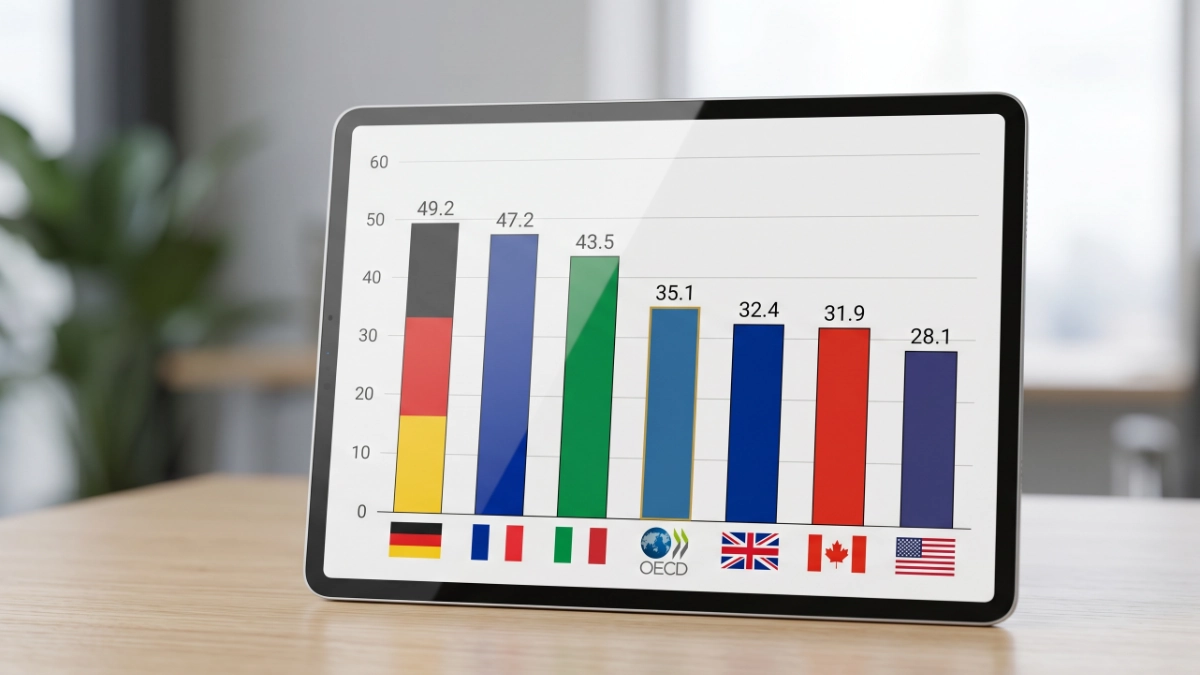
The OECD Taxing Wages 2026 flagship report, released today, April 22, 2026, has confirmed a decade-high surge in the global labor tax burden. The average “tax wedge”—the gap between what an employer pays to hire a worker and the worker’s final take-home pay—rose to 35.1% across 38 OECD member nations. This marks the highest level recorded since 2016, driven largely by persistent inflation and the phenomenon of “bracket creep.”
While nominal wages rose in 35 out of 38 countries, the report highlights that the state effectively “clawed back” a significant portion of these gains. In 24 countries, the tax wedge increased as tax thresholds failed to keep pace with wage growth, pushing middle-income earners into higher effective tax brackets without a corresponding increase in real purchasing power.
The G7 Landscape: Divergent Paths in 2026
The report reveals a stark divergence in how the world’s largest economies are managing labor costs. While some nations utilized social security levers to provide relief, others saw sharp increases due to policy shifts and fiscal drag.
| G7 Nation | 2026 Tax Wedge (Est.) | Trend / Driver |
| Belgium* | 52.5% | Remains the highest in the OECD. |
| Germany | 49.2% | Increase driven by higher Social Security Contributions (SSC). |
| France | 47.2% | Stable but remains among the highest globally. |
| United Kingdom | 32.4% | Largest OECD Increase (+2.45 p.p.) due to employer NI hikes. |
| United States | 28.1% | Slight decrease following state-level adjustments. |
| Italy | 43.5% | Notable decrease (-1.21 p.p.) due to targeted labor tax reliefs. |
| Canada | 31.9% | Marginal increase due to bracket creep in certain provinces. |
*Non-G7 included for benchmark purposes.
The “Bracket Creep” Crisis and Indexation
The OECD Taxing Wages 2026 report has officially labeled “fiscal drag” as the primary silent tax increase of the decade. As workers received raises to combat the cost-of-living crisis, the lack of automatic indexation in many tax systems meant the government became the unintended beneficiary of inflation.
- UK Focus: The UK recorded the largest year-on-year rise in the OECD. The combination of frozen personal allowance thresholds and the recent increase in employer National Insurance contributions has significantly cooled hiring sentiment in the service sector.
- Special Feature: This year’s report includes a deep dive into statutory progressivity, showing that while tax systems are becoming more progressive (taxing the wealthy more), the “middle-income trap” is widening as the average tax wedge for households with children increased faster (+0.46 p.p.) than for single workers.
OECD Analysis: “Taxing labor is often seen as the ‘easy’ route for revenue generation, but at 35.1%, the wedge is reaching a tipping point. High labor taxes discourage hiring and weaken work incentives at a time when global growth is already fragile.”
